
AI in Competitive Programming vs. Real-World Software Engineering: A Misleading Benchmark?
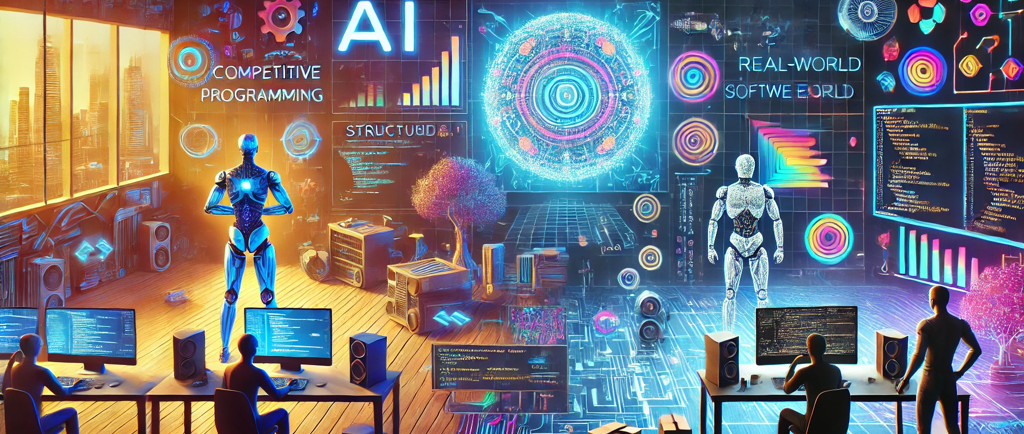
AI is making waves in competitive programming, but does that mean it can replace real-world software engineers? This article explores the gap between AI’s coding abilities in structured contests and the complexities of real-world development. It also covers what to look for when hiring AI-augmented programmers and why AI is a tool, not a replacement.
AIIT
2/14/20254 min read
Introduction
Artificial Intelligence (AI) has made remarkable progress in competitive programming, with models like OpenAI’s o3 achieving gold medal performance at IOI 2024 and competing with elite programmers on CodeForces. The research paper "Competitive Programming with Large Reasoning Models" ( 📖 ) presents AI as highly capable in algorithmic problem-solving.
However, does this translate to real-world software engineering? If you’re hiring a developer or managing software projects, should you consider AI as a replacement or just a tool for augmentation?
The answer lies in understanding AI’s limitations—especially when it comes to bugs, corner cases, and problem structuring.


The AI Competitive Programming Illusion
1. AI Excels in Structured Problem Solving
Competitive programming follows a predictable structure:
Clearly defined problem statements.
Well-established algorithmic patterns.
Fixed test cases for evaluation.
AI thrives here because:
✅ It recognizes patterns from vast training data.
✅ It applies brute-force search through massive sampling.
✅ It optimizes solutions for passing test cases, not understanding them.
But this doesn’t reflect real-world software development, where problems are ambiguous, evolving, and don’t come with predefined test cases.
2. The Effort Asymmetry: Problem Formulation vs. Solution Execution
One of the biggest overlooked issues is that formulating a problem is often harder than solving it:
Competitive programming problems require expertise to design.
The effort required to structure a problem correctly is often greater than the effort required to implement a known algorithmic solution.
Real-world engineering is exactly this—structuring ambiguous business needs into software requirements.
🔹Key Insight: AI is solving the easier half of the problem (execution), but the hard part is defining what needs to be solved.
3. AI’s Unacceptable Failure Rate in Software Engineering
The paper highlights that AI excels in scenarios where the primary challenge is selecting or recognizing an existing algorithmic pattern. However, it frequently fails at competitive programming:
AI scored below 100% on many challenges.
It was often penalized for missing edge cases.
These failures are tolerable in competitions but disastrous in real-world software.
In software development, a programmer encounters a mix of familiar and novel problems. When facing an unfamiliar challenge, a human relies on reasoning skills to determine whether their proposed solution is complete and robust.
AI, on the other hand, has immense computational power and an effectively unlimited, near-perfect memory. Yet, despite these advantages, it struggles with fundamental aspects of software engineering—especially when verifying correctness beyond predefined test cases. This inability to assess solutions beyond surface-level correctness remains one of AI’s biggest limitations.
Why AI’s Partial Correctness Is a Deal-breaker in Software Development
A human engineer understands causality—they know why a bug exists. AI does not. This is why a programmer using AI is far better than AI alone. Even a bad programmer still has some sense of causality, whereas AI will generate and ship incorrect code without questioning it.
4. AI is a Tool, Not a Replacement
If you’re hiring a developer today, you should not replace them with AI. But you should look for someone who:
✅ Knows how to use AI effectively (e.g., GitHub Copilot, ChatGPT, AI debugging tools).
✅ Can verify AI-generated code for correctness and maintainability.
✅ Understands software architecture and edge cases.
How to Test AI-Augmented Developers in Hiring
If you’re hiring a programmer, try these assessments:
Give them AI-generated code and ask them to find and fix hidden issues.
Provide an ambiguous software requirement and evaluate how they clarify and structure the problem before writing code.
Test their debugging skills—can they analyze why something failed rather than just retrying different solutions?
Conclusion: The AI-Driven Developer is the Future
For the record, I personally use AI frequently—even to write this article. It’s an excellent assistant, but not a replacement for human reasoning. The paper makes one thing clear—AI is becoming an excellent programming assistant, but not an autonomous software engineer. Competitive programming is a misleading benchmark because:
It removes problem formulation, which is the hardest part of engineering.
It allows partial correctness, which is unacceptable in real-world software.
It doesn’t measure debugging, maintainability, or architecture skills.
The best developers of the future will not be replaced by AI—they will be the ones who know how to use AI effectively. If you’re hiring today, look for a candidate who understands AI’s strengths and weaknesses, not one who blindly relies on it. 🚀
References
Research Paper: https://arxiv.org/abs/2502.06807
Only interested in new Articles
© 2025. All rights reserved.
For Discussions/Suggestions/Community
Be part of an engaging community where we discuss topics ranging from AI to Agile, Scrum practices, and software development challenges. Whether you’re looking to share your insights, ask questions, or simply keep up with the latest conversations, our Google Group is the place to connect.