
AI Can Code—But Can It Create?
AI Firings: A Trend Headed for Reversal? Over the past year, we’ve said this repeatedly: laying off engineers in favor of AI is a short-sighted and unsustainable move. Now, the cracks are starting to show—and some companies are quietly reversing course. Yet, even as this unfolds, some tech leaders are doubling down on the idea that AI will replace developers entirely. So what’s really going on?
AIIT
Sunny Narula
7/9/20257 min read
The Future of Coding Isn’t Fewer Engineers. It’s Better Problems.
There’s a growing chorus of tech CEOs predicting the end of software engineering as we know it. Anthropic CEO Dario Amodei recently claimed that AI would write 90% of code within the next 6 to 12 months 📖. Meta’s Mark Zuckerberg suggested that AI could eventually replace mid-level software engineers, implying that this shift could happen sooner than many expect 📖. The message seems clear: human coders are expendable.
When a CEO says ‘AI is the future,’ they’re not just making a prediction—they’re advertising a product. These statements are often strategic marketing, crafted to shape investor sentiment and public perception. They reflect business goals more than technical truths.
This kind of narrative frames AI as a near-infallible force. But the actual performance of AI on hard, real-world coding tasks paints a very different picture.


What AI Can Code—And What It Can’t
To be clear, AI tools have already made a huge impact on software development. Copilot, ChatGPT, and similar tools can autocomplete functions, write boilerplate code, and even generate test suites. In fact, Sam Altman of OpenAI has noted that in some companies, more than 50% of code is now AI-generated 📖.
But how much of that is innovation?
Despite bold claims, AI’s actual coding ability hits a wall when faced with complex or unfamiliar tasks.
1. Contest-Level Failures
In the HLCE benchmark—which tested AI on 235 Olympiad-level problems—the best large language model could solve only 15.9% of them. Many others failed entirely 📖. Similarly, on LiveCodeBench Pro, top-tier models like Claude and GPT-4 had a 0% success rate on hard problems 📖.
2. Freelance Task Performance
It’s not just contests. In real-world coding tests drawn from platforms like Upwork, OpenAI researchers found AI models struggled with bug fixes, feature requests, and refactoring tasks 📖 and 📖.
Even the best model—Claude 3.5 Sonnet succeeded at only 26.2% of developer-level tasks in a benchmark simulating freelance job platforms 📖.
3. Efficiency Problems
And when it comes to efficiency, AI code doesn’t measure up: the EffiBench benchmark showed GPT-4’s code ran 3× slower and used 13× more memory than human-written versions 📖.
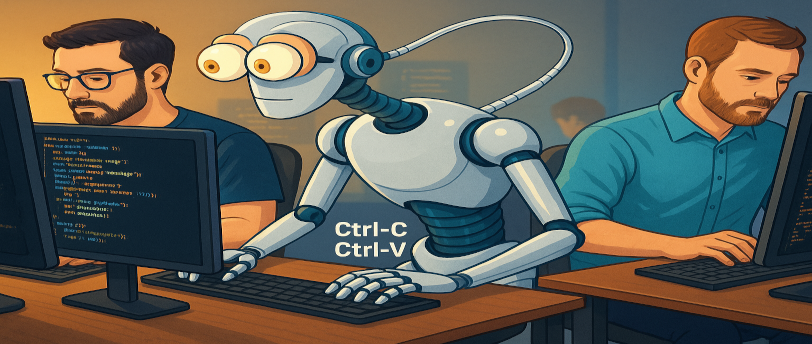
These findings echo a fundamental truth: AI excels at remixing known solutions—but it doesn’t know how to solve problems it hasn’t seen before.
The Real Problem: The Software Industry’s Shrinking Vision
Here’s the twist—maybe CEOs are right, but not because AI has become superhuman. Instead, the kind of software most companies are building today is increasingly commoditized: clones, CRUD apps, dashboards, marketplaces. AI can handle these because they’ve been built before. Repetition, not innovation, is the norm.
It’s as if the CEOs have decided: there are no new problems left—everything worth solving with code has already been solved. Innovation, it seems, is no longer market-friendly.
In this landscape, engineering becomes less about invention and more about integration. No wonder AI is mistaken for a silver bullet.
I’ve seen this play out firsthand. A friend of mine works at a fintech company that illustrates this exact pattern.
The company collaborates with major financial and government institutions globally, maintaining access to around 80 high-cost, hard-to-obtain licenses and data subscriptions. Their business model revolves around aggregating this data and repackaging it for resale—primarily to clients in stock trading, investing, and financial media. These clients often request custom front-ends tailored to their specific needs, but in reality, it's the same core services being wrapped and re-delivered with minor modifications. This model serves over 150 clients—and for a while, it worked.
Once regarded as a prestigious startup with excellent pay and engineering culture, the company was acquired by a new owner focused on maximizing margins through AI. Before any AI solution was fully deployed, they laid off 60% of the development team. Notably, they also fired all of their scrum masters, signaling a shift toward flat, AI-assisted workflows with minimal human coordination. (According to my friend, most of the laid-off developers quickly found jobs elsewhere.)
The remaining team, including my friend, was encouraged to adopt GitHub Copilot. He appreciated the tool—it sped up routine tasks—but the work hours quickly swelled from a typical 9-hour day to 12 or even 14. Raises were offered to retain those who stayed, but the burnout was real.
Within six months, the plan backfired. The AI integration didn't scale well, and productivity dropped. Now, the company is back in the market, scrambling to rehire developers—and struggling to find people with the skills they previously let go.
Engineers Aren’t Obsolete—Precision Still Matters!
AI makes mistakes—And software industry has no room for them.
If the software industry focused more on new, complex, unsolved problems, engineers wouldn’t just remain relevant—they’d be indispensable. AI can assist, yes—but when it comes to building correct, scalable, and secure systems, it can’t be trusted to work alone.
Think of it this way: when a junior developer is assigned to a senior, the expectation isn’t that the senior is now redundant. On the contrary—they’re more essential than ever, because now they're responsible for not just writing clean code, but reviewing, correcting, and guiding someone else’s work.
If AI requires constant review, debugging, validation, and oversight by experienced engineers—does that sound like something that reduces the need for senior developers? Or increases it?
The reality is, AI makes mistakes. That might be acceptable when generating a blog outline or drafting an email. But in software development, where correctness, efficiency, and security matter deeply, “almost right” is still wrong. If something compiles or just works, it is OK only some of the time under limited scenarios. Whenever there is any kind of pressure on the code—whether it’s performance critical or carries legal or financial implications—there is no room left.
IBM CEO Arvind Krishna says that AI might automate only 20–30% of code, and the real gain is productivity, not headcount reduction 📖.
So instead of asking, “How many developers can we cut?”, maybe we should be asking:
“Who will ensure this code actually works, scales, and doesn’t break under pressure?”
The Future of Engineering
In a world where AI can generate basic code, the role of the software engineer is evolving. It’s no longer about syntax or boilerplate—it’s about architecture, systems thinking, and defining the problem itself.
GitHub CEO Thomas Dohmke put it clearly:
“Smart companies will double down on developers, not cut them.” 📖
His view: the most innovative companies won’t replace engineers—they’ll empower them. 📖 He notes that AI enables developers to move faster—but the creativity, judgment, and innovation required to build meaningful software still rest with humans.
As Wired aptly put it, we may be heading into the era of “vibe coding,” where engineers guide AI through iterative scaffolding, correcting and curating along the way 📖. That’s still engineering—it’s just a new form.
For Founders and Engineers: A Challenge Worth Solving
If you're a developer recently laid off or a founder in search of direction, consider this: the real opportunity isn’t in replicating what's already been built. It's in venturing into the ignored, underinvested, and complex corners of the market—problems that can’t be solved by copying templates or stitching together APIs.
Startups are still being built to replace dashboards, CMSes, or marketing tools for the hundredth time. But what about:
Software for underserved industries?
Tools for low-margin or messy domains that AI can’t cleanly handle?
Complex B2B infrastructure that still runs on spreadsheets?
These are the markets where human insight, systems thinking, and domain expertise still matter deeply. If AI is the new junior dev, then the next generation of engineers must become architects—not just of code, but of vision.
Final Thoughts
Automation isn’t the enemy. But pretending AI can replace creative problem-solving? That’s wishful thinking.
The future of coding isn’t fewer engineers. It’s better problems.
So the question isn’t: Who can write the code quickly?
It’s: Who still dares to solve something new?
There’s a saying from software engineering: “Good, Fast, Cheap—pick any two.”
The industry today seems obsessed with Fast and Cheap.
But real innovation? That still demands Good—and that means humans who think deeply, solve creatively, and build carefully.
Support Us
If you liked this article, please consider donating to us to help keep us going. We support donations in major currencies.
📚 Further Reading
Fello AI. (2025). Anthropic CEO Predicts 90% of Code Will Be AI-Written in 6–12 Months. Link
LinkedIn. (2025). Mark Zuckerberg Predicts AI Will Replace Software Developers by 2025. Link
Windows Central. (2025). OpenAI CEO: AI Will Gradually Replace Engineers. Link
HLCE Benchmark. (2025). Large Language Models Struggle With Hard Programming Problems. Link
New benchmark reveals AI coding limitations despite industry claims. Link
SWE-Lancer: Can Frontier LLMs Earn $1 Million from Real-World Freelance Software Engineering? Link
EFFIBENCH: Benchmarking the Efficiency of Automatically Generated Code. Link
IBM’s CEO doesn’t think AI will replace programmers anytime soon. Link
GitHub CEO to engineers: 'Smartest' companies will hire more not less Software Engineers Link
GitHub CEO says AI won't replace developers because smart companies will now double down on engineers, not cut them Link
Futurism. (2024). OpenAI Researchers Admit Their AI Struggles With Real-World Coding. Link
Business Insider India. (2025). GitHub CEO Says Smartest Firms Will Hire More Engineers, Not Fewer. Link
Wired. (2025). Vibe Coding Is Coming for Engineering Jobs. Link
Only interested in new Articles
© 2025. All rights reserved.
For Discussions/Suggestions/Community
Be part of an engaging community where we discuss topics ranging from AI to Agile, Scrum practices, and software development challenges. Whether you’re looking to share your insights, ask questions, or simply keep up with the latest conversations, our Google Group is the place to connect.